

Table of Contents
ToggleVirtual reality trends 2026 point to a year of major shifts in how people use VR technology. Headsets are getting cheaper. AI is making experiences smarter. Businesses are finally taking VR seriously. And healthcare providers are finding real clinical value in immersive tools.
This isn’t hype. The VR market is projected to exceed $22 billion globally by 2026, driven by hardware improvements and expanding use cases beyond gaming. Whether someone is a developer, investor, or curious consumer, understanding these virtual reality trends 2026 will help them prepare for what’s coming.
Here’s what the year ahead holds for VR technology.
Key Takeaways
- Virtual reality trends 2026 highlight a shift toward affordable hardware, with standalone headsets dropping below $300 and improved comfort features driving mass adoption.
- AI is transforming VR experiences through faster environment creation, smarter NPCs, real-time translation, and personalized content adaptation.
- Enterprise VR adoption is accelerating as companies report up to 75% better training retention rates and 40% faster skill acquisition compared to traditional methods.
- Social VR platforms are maturing with better avatar systems, facial expression capture, and growing creator economies that let users earn real income.
- Healthcare applications are proving VR’s clinical value, from FDA-approved pain treatments to physical therapy programs that improve patient outcomes.
- The global VR market is projected to exceed $22 billion by 2026, signaling that virtual reality is moving beyond gaming into mainstream practical use.
More Affordable and Accessible Hardware
Price has been VR’s biggest barrier. That’s changing fast.
In 2026, standalone headsets will drop below $300 for entry-level models with decent specs. Meta, Sony, and newer players like ByteDance are competing hard on price. This competition benefits consumers directly.
The hardware itself is improving too. Expect lighter headsets with better weight distribution. Eye strain and motion sickness, two common complaints, are being addressed through higher refresh rates (120Hz becoming standard) and improved optics. Pancake lenses, which reduce headset bulk, will appear in more mid-range devices.
Wireless connectivity is another big win. Wi-Fi 7 adoption means PC VR users can ditch cables without sacrificing visual quality. This makes setup easier and removes a major friction point for casual users.
Accessibility features are expanding as well. More headsets will include adjustable IPD (interpupillary distance) settings for different face shapes. Voice controls and hand tracking are becoming standard, reducing reliance on controllers.
The bottom line? VR hardware in 2026 will feel less like expensive tech gear and more like a normal consumer product. That shift opens doors for mass adoption.
AI-Powered Immersive Experiences
AI is reshaping what VR can do, and 2026 will showcase this clearly.
Generative AI tools now help developers create VR environments faster. Instead of hand-modeling every object, creators can use AI to generate textures, landscapes, and even entire scenes from text prompts. This cuts development time significantly and lowers costs for indie studios.
NPCs (non-player characters) are getting smarter. Large language models enable characters that respond dynamically to player speech and actions. Conversations feel less scripted. This changes gaming, training simulations, and educational VR experiences.
Real-time translation is another AI feature gaining traction. Users can speak in one language and hear responses in another, all within the headset. This makes social VR more global and removes language barriers in virtual meetings.
Personalization is improving too. AI can track user preferences and adapt experiences accordingly. A fitness app might adjust workout intensity based on heart rate data. A meditation app could modify visuals based on stress indicators.
These virtual reality trends 2026 show AI isn’t just a buzzword here. It’s delivering practical improvements users will notice immediately.
Enterprise and Workplace Adoption
Businesses spent years experimenting with VR. In 2026, many are moving from pilot programs to full deployment.
Training is the biggest use case. Industries like manufacturing, healthcare, and aviation use VR to simulate dangerous or expensive scenarios safely. Walmart trained over a million employees using VR modules. Airlines use VR for cockpit familiarization. Hospitals practice surgical procedures without risk to patients.
The ROI is becoming clear. Studies show VR training can improve retention rates by up to 75% compared to traditional methods. It also reduces training time, some companies report 40% faster skill acquisition.
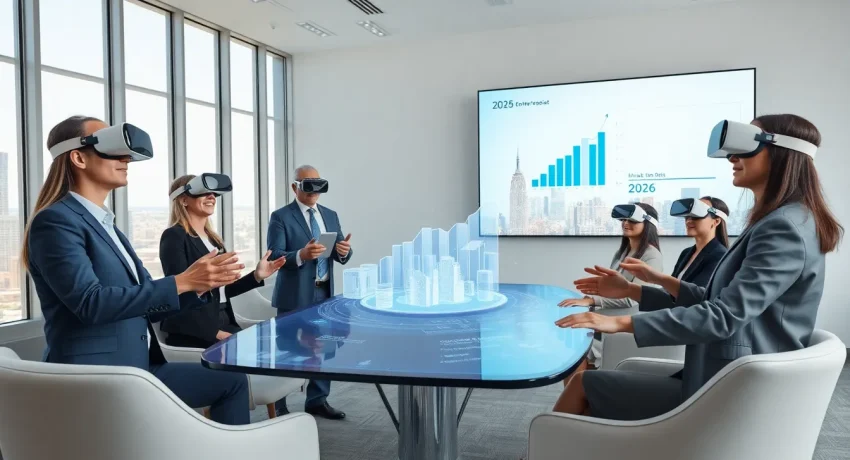
Remote collaboration is another growth area. Virtual meeting spaces offer more presence than video calls. Users can manipulate 3D models together, whiteboard ideas in shared space, and feel like they’re actually in the same room. For distributed teams, this matters.
Design and prototyping benefit too. Architects walk clients through buildings before construction starts. Car manufacturers review vehicle interiors at full scale. These applications save money by catching problems early.
Virtual reality trends 2026 in enterprise focus on practical value, not novelty. Companies want results, and VR is delivering them.
Social VR and the Metaverse Evolution
Remember the metaverse hype? It hasn’t disappeared, it’s just getting more realistic.
Social VR platforms are maturing. Apps like VRChat, Rec Room, and Horizon Worlds have millions of monthly users. These spaces host concerts, comedy shows, and casual hangouts. For younger users especially, virtual socializing is becoming normal.
In 2026, expect better avatar systems. Full-body tracking is becoming more accessible, making avatars move more naturally. Facial expression capture, once limited to expensive studio setups, is appearing in consumer headsets. This makes virtual interactions feel more human.
Interoperability is a slow but steady trend. The Metaverse Standards Forum, backed by major tech companies, is working on common protocols. The goal: users should carry their avatars and digital items across different platforms. Progress is incremental, but it’s happening.
Creator economies are expanding. Users build and sell virtual items, experiences, and spaces. Some earn real income from their VR creations. Platforms are improving tools to make creation easier for non-technical users.
Social VR won’t replace physical interaction. But for long-distance relationships, remote communities, and specific use cases, it offers something video calls can’t match. Virtual reality trends 2026 show social platforms finding their niche rather than trying to replace reality entirely.
Health, Fitness, and Therapeutic Applications
Healthcare is taking VR seriously, and the results are promising.
Physical therapy uses VR to make rehabilitation engaging. Patients recovering from strokes or injuries complete exercises in game-like environments. They stay motivated longer and often recover faster. Studies show improved outcomes compared to traditional therapy alone.
Mental health applications are expanding. VR exposure therapy helps patients confront phobias in controlled settings. Someone afraid of heights can gradually experience virtual elevations. PTSD treatment uses similar approaches. The FDA has approved VR-based treatments for chronic pain.
Fitness apps continue growing. Beat Saber, Supernatural, and similar titles turn exercise into entertainment. Users burn calories without the tedium of traditional workouts. Some health insurers now cover VR fitness subscriptions as preventive care.
Medical training benefits significantly. Surgeons practice procedures repeatedly before touching real patients. Medical students examine virtual cadavers. These applications reduce errors and improve confidence.
Elderly care is an emerging area. VR can reduce isolation for seniors with limited mobility. Virtual travel experiences and social connections improve mental well-being in care facilities.
These virtual reality trends 2026 in health show VR moving from entertainment into genuine clinical and wellness value. It’s not just games anymore.

