

Table of Contents
ToggleVirtual reality ideas are transforming how people work, learn, play, and connect. The technology has moved far beyond gaming headsets in basements. Today, VR powers surgical training, remote collaboration, mental health treatment, and immersive storytelling. Global spending on VR and AR is expected to exceed $72 billion by 2024, according to IDC research. This growth reflects genuine demand across industries seeking practical solutions to real problems. From architects walking clients through unbuilt buildings to therapists treating phobias in controlled environments, virtual reality applications continue to expand in surprising directions. This article explores the most promising virtual reality ideas across entertainment, education, healthcare, and workplace collaboration.
Key Takeaways
- Virtual reality ideas now span far beyond gaming into healthcare, education, workplace collaboration, and immersive entertainment.
- VR-based medical training has shown up to 230% better performance outcomes compared to traditional learning methods.
- Mental health treatments using VR, including exposure therapy for phobias and PTSD, deliver effective results in controlled, adjustable environments.
- Virtual workspaces and collaboration tools help remote teams feel more present and engaged than standard video calls.
- Industries like real estate, architecture, and corporate training use virtual reality ideas to reduce costs, improve safety, and enhance client experiences.
- Global spending on VR and AR was projected to exceed $72 billion by 2024, reflecting strong demand across multiple sectors.
Immersive Entertainment and Gaming Experiences
Gaming remains the most visible application of virtual reality ideas. The industry has evolved dramatically since early VR headsets delivered pixelated, motion-sickness-inducing experiences. Modern devices like the Meta Quest 3 and PlayStation VR2 offer sharp displays, intuitive controls, and libraries of polished titles.
But gaming is just the starting point. Virtual concerts have emerged as a major entertainment category. Artists like Travis Scott and Ariana Grande have performed for millions of fans in virtual venues. These events combine live music with visual spectacles impossible in physical spaces, think floating stages, morphing environments, and interactive elements that respond to crowd energy.
Virtual tourism represents another growing segment. Users can explore the Louvre, walk through ancient Rome, or dive the Great Barrier Reef from their living rooms. These experiences serve people with mobility limitations, budget constraints, or simple curiosity about distant places.
Film and storytelling have also embraced VR. Directors now create 360-degree narratives where viewers choose their perspective. Horror experiences place audiences inside the story rather than watching from a safe distance. Documentary filmmakers use VR to build empathy by letting viewers experience refugee camps, climate disasters, or historical events firsthand.
Sports broadcasting experiments with virtual reality ideas too. Fans can watch basketball games from courtside seats or experience a Formula 1 race from the driver’s perspective. These applications blur the line between spectating and participating.
Virtual Reality in Education and Training
Education stands to gain enormously from virtual reality ideas. Traditional learning often struggles to maintain student engagement. VR changes that equation by placing learners inside the subject matter.
Medical schools now use VR for anatomy instruction. Students can examine 3D organs, simulate surgeries, and practice procedures without risk to patients. Stanford Medical School reported that students trained with VR demonstrated 230% better performance than those using traditional methods.
Corporate training programs have adopted VR for similar reasons. Walmart trains employees using virtual reality simulations of Black Friday crowds and active shooter scenarios. Workers practice responses in realistic conditions without actual danger. The retail giant expanded VR training to all 200+ U.S. training centers after seeing improved employee confidence and retention.
Skilled trades benefit from virtual reality training as well. Welders can practice techniques without wasting materials. Electricians can work on virtual systems before touching live wires. Aviation mechanics can disassemble jet engines repeatedly without needing an actual aircraft.
Language learning takes on new dimensions in VR. Applications place students in virtual cafes, airports, and shops where they must use target languages to accomplish goals. This immersion accelerates acquisition compared to textbook study alone.
K-12 education uses VR for field trips impossible in real life. Students can visit the International Space Station, walk with dinosaurs, or explore the human bloodstream at microscopic scale. These experiences make abstract concepts tangible and memorable.
Healthcare and Therapeutic Applications
Healthcare applications represent some of the most impactful virtual reality ideas currently in development. Mental health treatment has embraced VR with particular enthusiasm.
Exposure therapy for phobias works exceptionally well in virtual environments. Patients afraid of heights, spiders, flying, or public speaking can confront their fears gradually in controlled settings. Therapists can adjust intensity in real time. A patient afraid of flying might start by looking at a plane, progress to sitting in a virtual cabin, and eventually experience a simulated flight with turbulence.
PTSD treatment using VR has shown promising results with veterans and trauma survivors. Programs recreate triggering environments so patients can process experiences with professional support. The VA has implemented VR therapy programs at multiple facilities nationwide.
Pain management offers another compelling use case. Burn victims at Harborview Burn Center in Seattle use a VR game called SnowWorld during wound care. Patients immersed in snowy landscapes report significant pain reduction compared to standard care. The brain’s attention capacity appears limited, engaging it with virtual stimuli leaves less bandwidth for processing pain signals.
Physical rehabilitation benefits from VR as well. Stroke patients practice motor skills through gamified exercises that make repetitive therapy more engaging. Sensors track movement and progress with precision impossible in traditional settings.
Surgical planning uses VR to let doctors practice complex procedures on patient-specific 3D models. Surgeons can rehearse approaches and anticipate complications before making a single incision. This preparation reduces operating time and improves outcomes.
Social Interaction and Virtual Workspaces
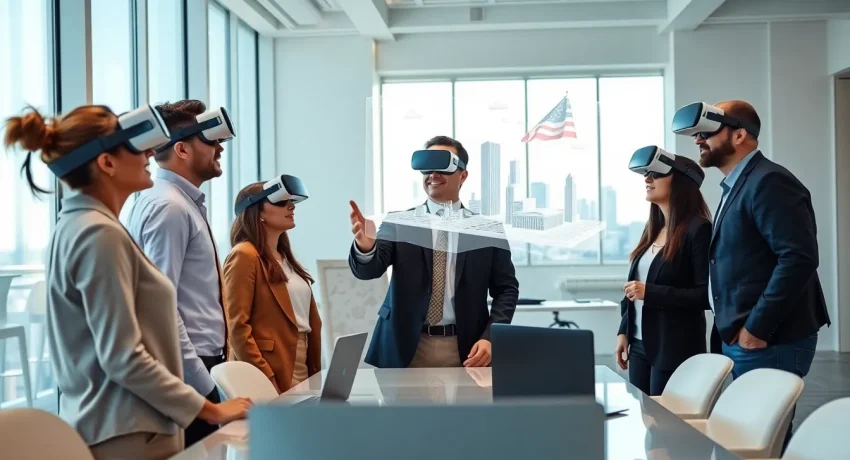
Remote work acceleration has sparked intense interest in virtual reality ideas for collaboration. Video calls fatigue participants partly because they lack the spatial presence of in-person meetings. VR promises something closer to physical co-presence.
Platforms like Horizon Workrooms and Spatial let distributed teams meet in virtual offices. Participants appear as avatars around shared whiteboards and screens. Early adopters report that VR meetings feel more engaging than flat video calls. The ability to gesture, move around a space, and make eye contact (simulated through head tracking) adds social cues missing from traditional video conferencing.
Virtual events and conferences have gained traction since the pandemic. Organizers can host thousands of attendees in virtual venues with networking spaces, exhibition halls, and breakout rooms. Attendees save travel costs and time while still experiencing something more interactive than watching a livestream.
Social VR applications like VRChat and Rec Room attract millions of users seeking connection. People attend virtual parties, play games together, and form communities across geographic boundaries. For individuals with social anxiety or mobility limitations, these platforms provide social outlets otherwise difficult to access.
Design and architecture firms use collaborative VR to review projects with clients. Walking through a virtual building reveals spatial relationships that blueprints cannot communicate. Clients can request changes while standing in the space, reducing costly revisions during construction.
Real estate has adopted VR for remote property tours. Buyers can visit homes across the country without traveling. This capability proved valuable during pandemic restrictions and has remained popular since.

